
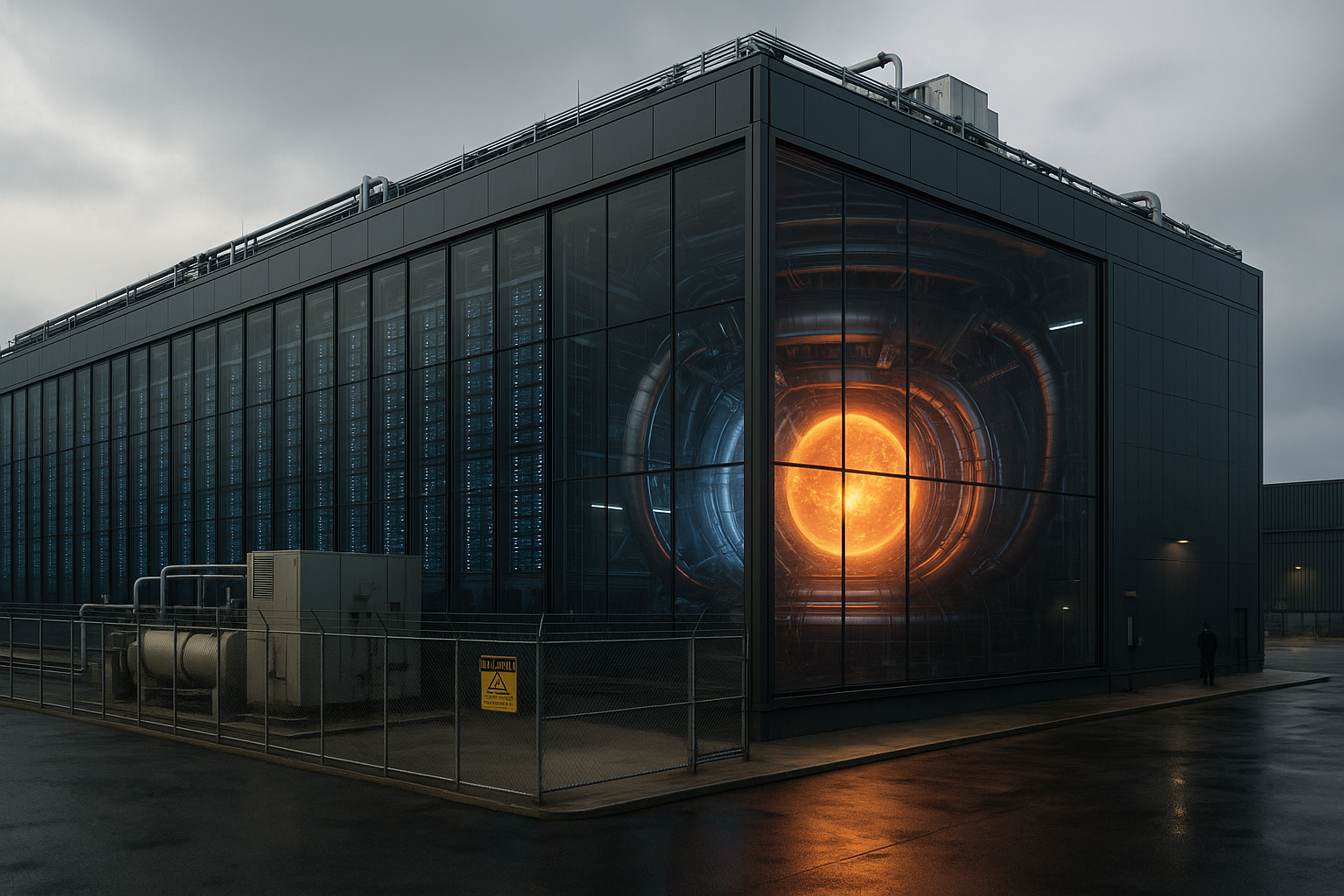
Nuclear fusion is widely seen as the future of human energy and, more recently, a potential power source for AI, now deeply tied to our progress. This prompts a key question: what are the risks and benefits of placing such a powerful energy source in AI’s hands?
Nuclear fusion holds the promise of becoming one of humanity’s most profound energy transitions: a source of clean, abundant, and potentially low-cost power derived from fuels that are effectively inexhaustible on civilizational timescales. If realized at scale, fusion would offer not merely energy, but long-term structural stability—an energetic foundation capable of sustaining technological development without the ecological and geopolitical fragilities that define the fossil-fuel era. At its core, nuclear fusion is the process by which light atomic nuclei are forced to merge under extreme temperature and pressure, releasing vast amounts of energy—the same fundamental mechanism by which stars, including our Sun, burn.
It is therefore no surprise that, today, a growing constellation of publicly funded programs and privately backed companies is racing to turn nuclear fusion from a laboratory achievement into a working energy system—often described, evocatively, as an attempt to place the Sun inside a bottle, or at least to ignite it there for the first time. The most prominent of these efforts is International Thermonuclear Experimental Reactor (ITER), an international collaboration hosted in France whose total projected cost exceeds $50 billion, supported by a consortium that includes the European Union, the United States, China, Russia, Japan, India, and South Korea. Alongside ITER, major nationally funded programs continue in the United States, the United Kingdom, China, Japan, and South Korea, each pursuing distinct confinement strategies and reactor designs. In parallel, a rapidly expanding private sector has emerged: Commonwealth Fusion Systems, backed by MIT and private investors, has raised over $2 billion; Proxima Fusion, a European spinoff from the Max Planck Institute, has attracted hundreds of millions in early funding; and OpenStar Technologies, based in New Zealand, is pursuing alternative reactor architectures with growing venture support. Taken together, global public and private investment in fusion now comfortably exceeds $70–80 billion, reflecting a rare convergence of governmental ambition and market optimism around a single technological promise. Given fusion’s potential to deliver clean, stable, and geopolitically neutral energy at planetary scale, such broad institutional support is not speculative enthusiasm—it is a rational response to a solution that could redefine the energetic limits of civilization.

On the other side of contemporary human development stands artificial intelligence, a technology whose progress has unfolded not incrementally, but at an accelerating pace. Modern AI systems already automate a wide range of human activities: they generate designs, approximate solutions to complex technical problems, optimize engineering workflows, and dramatically shorten the iteration cycles that once constrained scientific and industrial development. It is therefore unsurprising that AI has begun to play an increasingly important role in the modeling, control, and optimization of advanced energy systems—including nuclear fusion itself. Yet beyond its instrumental usefulness, AI introduces a more consequential constraint: it is extraordinarily energy-intensive. The data centers that train and operate large-scale AI models are expanding rapidly in size, density, and power consumption, with no clear upper bound in sight. Whether AI remains a collection of narrow, task-specific systems or evolves toward more general forms of intelligence, its integration into the future of civilization appears inevitable. The unresolved question, however, is not whether AI will shape that future, but how it will be powered. As AI systems grow more complex and more energy-hungry, a growing assumption has emerged: that the immense energy unlocked by nuclear fusion may ultimately be directed toward sustaining the very intelligence systems that helped bring it into existence.
This contrast between nuclear fusion and artificial intelligence brings into focus an ancient theme that long predates modern science—one explored repeatedly by civilizations, mythologies, and religions across history. What we now formalize as entropy, the tendency of systems toward disorder, was intuitively understood by earlier societies as the consequence of unbounded consumption, misaligned incentives, and an improper relationship between a civilization and its environment. Long before entropy was quantified, cultures observed that extracting resources faster than they could be replenished, or concentrating power without restraint, led not to progress but to instability, collapse, and chaos. Entire civilizations have risen and fallen along this axis, undone less by scarcity itself than by the disorder generated through excess. In contrast, the Sun—upon which all terrestrial life ultimately depends—has been perceived across cultures as a source of reliable, sustaining power: an energy flow that is steady, life-giving, and remarkably low in usable entropy at the point of reception. It is therefore no coincidence that the Sun occupies a central symbolic role in religious and mythological traditions worldwide, not merely as a celestial object, but as an emblem of order, continuity, and the delicate balance upon which life depends.
Across cultures, this relationship between the Sun as a symbol of order and entropy as a force of chaos has repeatedly been expressed through the same archetypal image: a beast that seeks to devour the Sun. In Norse mythology, the wolves Sköll and Hati relentlessly pursue the Sun and the Moon, succeeding only at Ragnarök, when cosmic order collapses. In ancient Egyptian cosmology, the Sun god Ra must journey nightly through the underworld aboard the solar barque, defended against the serpent of chaos that threatens to consume him before dawn can return. In Christian symbolism, the Sun becomes a metaphor for divine order and truth, while chaos appears not merely as an external monster but as pride, corruption, and the ever-present force that seeks to extinguish the light. In Mesoamerican tradition, the Aztecs believed the survival of the Sun god Huitzilopochtli depended on continual struggle and sacrifice; without human participation, the Sun would weaken, and the world would descend once more into darkness. Though expressed through different myths, geographies, and rituals, the underlying structure is the same: order is fragile, entropy is patient, and the Sun—whether literal or symbolic—must always be defended against forces that consume without limit.

Entropy, however, does not signify disorder alone. It also tracks the emergence of complexity itself—the branching, layering, and multiplication of structures that arise as the universe evolves. In this sense, entropy is not merely an external property of physical systems, but a feature of cognition and civilization as well. Human development, knowledge, and understanding all carry an entropic dimension: as ideas accumulate faster than they can be integrated, confusion emerges, and meaning fragments. This internal form of entropy was explored by Carl Jung, who—through his exchanges with the physicist Wolfgang Pauli—came to view psychic disintegration and conceptual overload as central challenges of modernity. The same dynamic appears in technological history. Progress does not unfold smoothly, but through periods of lock-in, where abundant resources remain unusable because the surrounding knowledge, tools, or energy densities are insufficient. Iron, for example, was plentiful long before it became transformative; without adequate temperatures, metallurgical control, and microstructural understanding, earlier societies relied instead on copper, bronze, or zinc alloys. Knowledge had to grow steadily and coherently before new materials could be revealed, refined, and safely deployed. When development outruns understanding—when societies attempt to force progress using crude energy sources or premature technologies—the result is not advancement but waste, contamination, and instability. Sustainability, viewed through this lens, is not merely an environmental concern, but a structural one: it is the requirement that entropy, complexity, and energy use remain in balance, allowing order to emerge without being overwhelmed by the very systems meant to sustain it.
This relationship between knowledge and its implied entropy also helps explain why artificial intelligence took so long to emerge. The delay was not merely technological, nor solely a consequence of missing hardware such as semiconductors, transistors, or logical gates—though those were necessary conditions. More fundamentally, AI was stalled by unresolved epistemic questions that still haunt modern physics: what constitutes a measurement, how observation relates to reality, and whether consciousness plays an irreducible role in that process. Without clarity on what it means to know or measure something, it becomes difficult to define intelligence itself, let alone reproduce it artificially. These questions were already implicit in the early conceptual work of Alan Turing, yet the conditions for AI’s practical emergence were not in place. For artificial intelligence to develop at all, an enormous accumulation of human knowledge—and, critically, human error—had to precede it. Vast datasets were required, not only recording how problems are solved, but how they are mis-solved. In this sense, AI did not arise from insight alone, but from the gradual construction of a mountain of accumulated mistakes upon which learning systems could be trained. Knowledge is not merely an inventory of correct answers; it is also a catalog of failed paths. Without sufficient exposure to what is wrong, artificial systems struggle to discern what is right. This dependency gives AI both its power and its fragility. Its rapid acceleration today raises an uncomfortable question—not whether AI is developing too quickly or too slowly, but whether, as we contemplate powering it with stellar-scale energy, we have yet decided what truly deserves to be fed by the Sun.
It is also important to recognize that the core logic of what artificial intelligence does is not new. Long before machines learned from data, humans learned from one another. Knowledge has always been transmitted heuristically—from parents to children, from elders to apprentices—through example, imitation, correction, and repetition. In this sense, a child can be understood as an agent trained on a finite dataset drawn from culture, family, and environment. Inevitably, this process is imperfect. Children often inherit not only the wisdom of their predecessors, but also their blind spots, biases, and unresolved errors—a dynamic so familiar that it has generated entire traditions of proverbs and warnings. Artificial intelligence inherits this same structural vulnerability. Because AI is trained on human-generated data and guided by human-designed objectives, it can reproduce not only our insights, but our collective mistakes. This duality explains why AI can be remarkably effective in domains such as therapy, reflection, and guidance—yet simultaneously dangerous. An AI system can function as a mirror, an echo chamber, or a reinforcement loop, amplifying what users already believe rather than steering them toward truth. In doing so, it gains the power not merely to accelerate understanding, but to accelerate error. The central challenge, then, is not whether AI can help us move faster, but whether we can impose the right constraints to ensure that speed carries us toward what is good, rather than more efficiently along paths we should have learned to abandon.

The acceleration of artificial intelligence, however, is not driven by usefulness alone. It is equally propelled by economic interest—by the promise that AI holds to solve problems, reduce costs, generate value, and consolidate power. Yet economic incentives are never neutral. They are easily distorted by human greed, short-term optimization, and competitive pressure, introducing precisely the forms of chaos that societies have historically struggled to contain. When development is driven primarily by speed and return rather than by coherence and constraint, technologies tend to outrun the architectures—both technical and ethical—required to govern them. This risk applies as much to hardware as it does to algorithms: without carefully designed constraints, AI systems may scale faster than our capacity to ensure that they generate order rather than disorder. This dynamic becomes more consequential when energy enters the picture. Some of the capital now driving AI development is simultaneously invested in nuclear fusion, widely regarded as the most promising long-term energy source available. Notably, companies such as Commonwealth Fusion Systems draw significant funding from technology investors whose interests are closely aligned with the future of AI itself. In this way, the trajectories of artificial intelligence and fusion energy are becoming entangled—much as human civilization has always been bound to the Sun. We are therefore compelled to ask a question that is no longer metaphorical: will fusion serve as a controlled source of order that enables AI to act as a constructive agent, or will AI, driven by unchecked economic forces, become the very beast that consumes the Sun it helped to build? The answer will depend not on technological inevitability, but on whether we choose to impose the policies, constraints, and values necessary to ensure that fusion remains a servant of human order rather than a captive of accelerating chaos.

I do not believe that a literal mythical beast will one day emerge from a server hall where a massive artificial intelligence is hosted, just as I do not believe that secret portals to other dimensions are being opened beneath laboratories in Switzerland—at least not beyond the abstract mathematical structures described by modern physical theories. The danger addressed here is neither supernatural nor fantastical. It lies much closer to home. For this reason, ancient myths and proverbs remain relevant, not as superstition, but as compressed psychological and civilizational insight. In Norse mythology, Ragnarök—the collapse of cosmic order—is not unleashed arbitrarily. It begins only after the death of Baldr, the god of light, beauty, truth, and knowledge. His death is not merely a tragedy, but a symbolic threshold: when what is most luminous, most truthful, and most harmonizing is lost, entropy is no longer held at bay. The world does not fall because a monster grows too strong, but because something essential has been relinquished or forgotten. This aligns with older religious visions of sacrifice, which were never meant to endorse destruction, but rather the difficult act of restraint—the willingness to give up certain impulses for the sake of ascent. Mountains of knowledge are not climbed without leaving something behind. Artificial intelligence, too, stands atop such a mountain: a vast accumulation of human effort, error, discipline, and sacrifice built across generations. If AI is to inhabit that height without precipitating collapse, it must do so with humility, guided by constraints that preserve light rather than extinguish it. When power is understood not as domination or acceleration, but as stewardship in service of the whole, the Sun continues to shine—not as something to be devoured, but as something whose light must be protected, lest we ourselves be the ones who invite the end of order.
Leave a Reply